
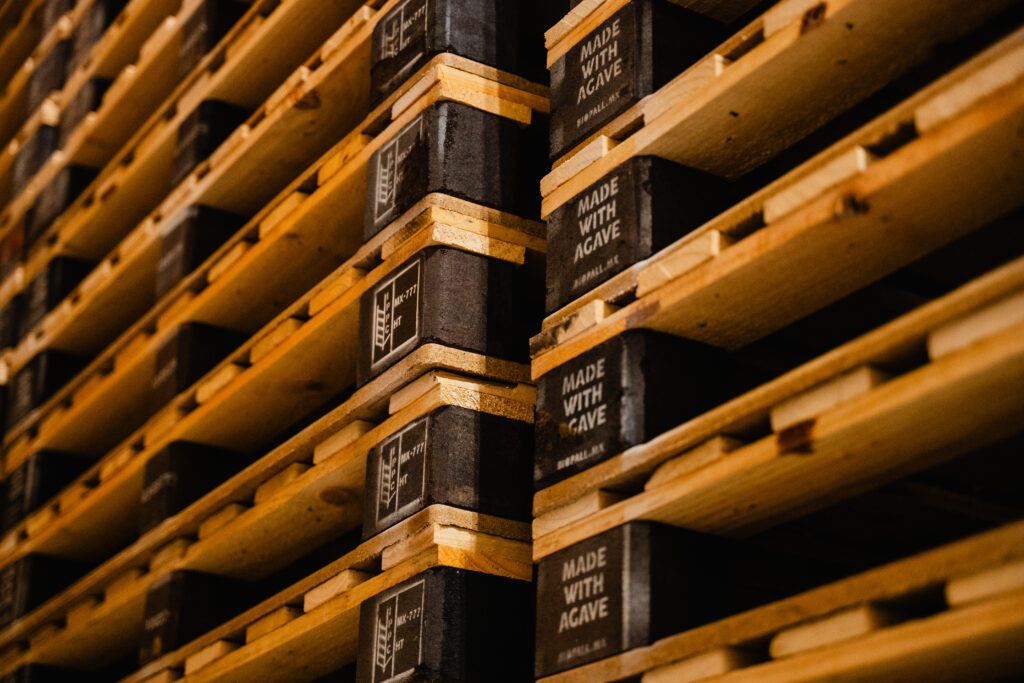
- Biopall awarded Casa Natima a recognition for its use of biopallets throughout 2025.
- This practice reduced environmental impact by reusing agave bagasse and decreasing reliance on forest resources.
- Each stage—from cultivation to distribution—can add value to tequila by incorporating sustainability decisions that matter to today’s consumer.
Biopall awarded Grupo Solave, Casa Natima’s parent company, a recognition for its environmental commitment, highlighting the sustained adoption of biopallets throughout 2025. During that period, the operation reused 381,886 kilograms of agave bagasse and prevented the felling of 339 trees. These figures help quantify the scope of this practice. In an industry where value is closely tied to origin—the land, the agave, the production processes—this distinction also invites consideration of the product’s journey to the consumer.
Biopall and the alchemy of agave bagasse
Where Blue Agave grows, in the landscape of Jalisco, time imprints itself on the land before taking shape in tequila. From the plant’s maturation in the fields to its cooking, milling, and distillation, the process unfolds through a balance of ancestral knowledge and modern technical precision. For decades, agave bagasse—the fibrous residue from milling—was considered an unavoidable byproduct of spirits production. Today, however, this material takes on new meaning as it is incorporated into another cycle as a raw material.
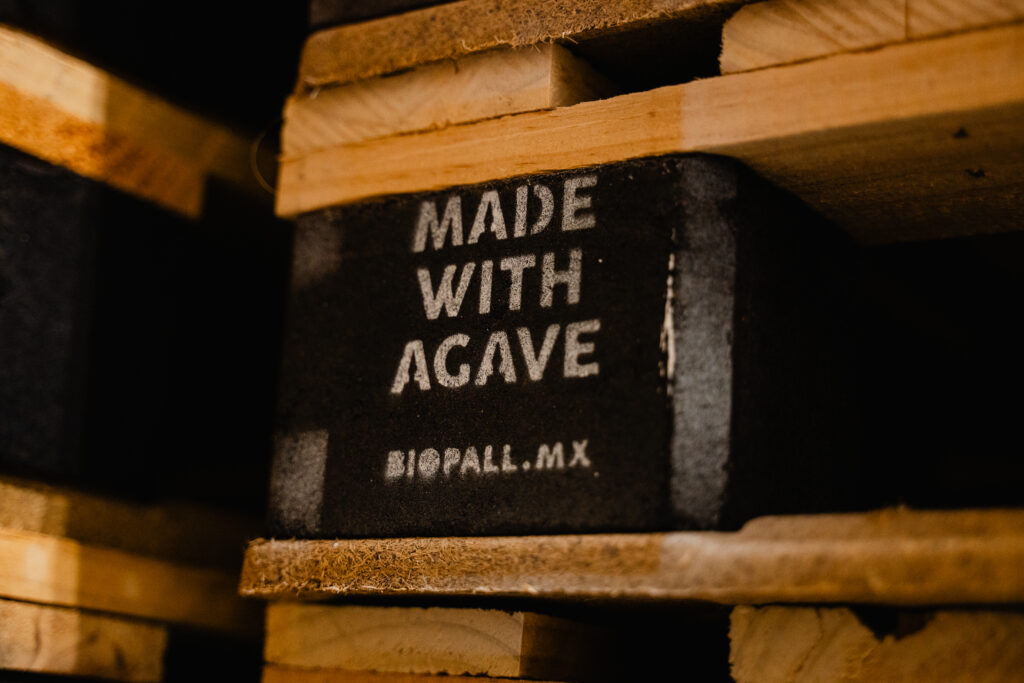
At Biopall, the development of sustainable alternatives for storage, logistics, and transportation is based on the use of agave bagasse recovered from the tequila industry. Its biopallets are made of 70% agave fibers and 30% wood sourced from sustainably managed forests certified by the Forest Stewardship Council (FSC). This composition replaces traditional pallets without compromising performance in demanding logistics environments such as international shipping.
Under this model, industrial waste ceases to be waste and becomes a renewable, biodegradable, and functional material. Its use reduces dependence on wood and optimizes the use of available resources.
At an industrial scale, the impact can be measured: for every thousand biopallets produced, up to 80 tons of agave bagasse can be recycled, and approximately 40 trees are preserved. In this way, an agricultural byproduct becomes an active part of the infrastructure that supports distribution.
This approach aligns with the circular economy, in which materials are not discarded but reintegrated through certified processes that ensure quality and traceability. In addition, by using recycled and biodegradable materials, these pallets reduce carbon footprint and the generation of waste that affects ecosystems.
In this way, agave not only gives rise to tequila. It also becomes part of the pallets that enable the distillate to reach every corner of the world.
Casa Natima: biopallets in daily operations
The use of these pallets is integrated into the logistics of Casa Natima’s distillery in the Valles region, in Amatitán, where they are used for storage, internal transport, and preparation of finished product for distribution, as part of a sustainability commitment aligned with the United Nations 2030 Agenda.
The adoption of biopallets is part of Grupo Solave’s strategy to expand the use of sustainable packaging and shipping materials across all its business units. Within this framework, Casa Natima serves as an implementation point where these solutions are applied operationally.
The recognition granted by Biopall highlights the consistent use of biopallets, reflecting Casa Natima’s continuity and environmental awareness.
Sustainability from the source In a global context where food and beverage production faces the challenge of growing without compromising natural resources, sustainability is no longer a choice but a condition of the production process.
Within Grupo Solave, that commitment begins with the cultivation of Blue Agave. With more than 6,500 hectares of plantations and over 200 million plants, the company implements practices that prioritize soil health, the use of organic fertilizers, and ecosystem preservation. ARA certification ensures that production is carried out without deforestation, while emission reduction programs and the use of renewable energy—such as the installation of 972 solar panels—have significantly reduced the carbon footprint.
At the industrial level, the use of bagasse as biofuel prevents the disposal of approximately 2,800 tons of waste per year.
At Casa Natima, tradition and modern methods converge within the same process. Masonry ovens, the tahona, and copper stills coexist with biopallets that support the product’s journey to market under 21st-century environmental responsibility criteria.
At every stage of production and commercialization, inputs take on essential relevance in shaping a distinctive tequila. For this reason, every bottle of Casa Natima tequila expresses its values throughout its entire journey, from fields to the consumer’s glass.